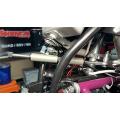



When a motorcycle or quad rider presses the rear brake pedal and squeezes the front brake lever to slow down, a whole mechanism is set in motion to lower your speed!
Why replace brake pads?
It's essential to keep your brake pads in good condition, by checking them regularly and changing them when they start to wear. If brake pads are not replaced in time, braking will no longer be under optimum conditions. This means longer braking distances and loss of vehicle control. To ensure safety, it's imperative to replace brake pads as soon as the first warning signs appear.
Signs of brake pad wear :
- Pad thickness
- Vibrations of varying intensity
- Noises: grinding or rubbing
- Jolts or jerks
- Brake heat (odors)
- Longer braking distances
- Pedal too hard or too soft
- A lever that's too hard or too soft. Brake lining thickness affects lever travel, which can be compensated for by adjusting the brake fluid level.
Wear varies from one vehicle to another, depending on driving style and outdoor conditions. For cross-country use, you'll need to change brake pads more often than for enduro or road use.
As soon as the pad thickness decreases and reaches the minimum limit imposed by the manufacturer's standards, the pads must be replaced.
Good braking is fundamental to safety, and it's only natural to try and optimize it by taking care of the pads yourself. Be careful, however, to choose the right model for your driving style and the quality of your discs.
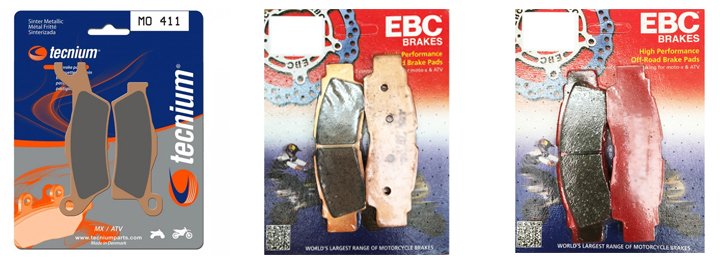
THE 3 TYPES OF PADS FOR QUADS, SSV & MOTOCROSS :
The Sinter's strength lies in its resistance to heavy use, making it ideal for disciplines such as cross-country and enduro (quad or motorcycle). They can withstand the most extreme conditions. The manufacturing process consists of sintering metal particles under heat and pressure to form a highly resistant sintered material.
Metal brake pads (SINTER) provide a stable coefficient of friction and are particularly resistant to high temperatures (up to 600°C), rain and mud.
Sinter brake pads offer more powerful, more progressive, more precise braking and a wider range of use.
Before fitting sintered metal, make sure your discs can withstand it, otherwise you may damage their surface. Cast-iron discs do not stand up well to metal brake pads (sintered SINTER). Metal brake pads wear down brake discs more quickly.
For standard use, road travel and touring, organic is suitable. Ideal for cast-iron discs. They are made from aramid fibers and insulating materials bonded together with resin. Organic brake pads cause less wear to the brake disc, are quieter and produce less dust.
They wear more quickly and do not withstand heat as well. Once they reach maximum temperature tolerance, they rapidly lose their coefficient of friction. They have poor resistance to moisture and mud, and can form a layer on the surface, reducing braking performance.
Depending on the percentage of Kevlar, they only become effective above a temperature of 150 to 200°C. In other words, they are often less effective (and more dangerous) than simple organics.
To make the best choice in terms of brake pads, rely on the use you make of your motorcycle, quad or SSV.
Our disassembly tips:
- Remove a small amount of brake fluid from the jar with a small syringe, as the level will rise during reassembly and may overflow the jar.
- Dismantling the caliper: simply remove the fixing screws and, with a little manipulation, you'll be able to pull it out of the disc.
- Remove the pins that hold the pads in place. Depending on the model, these pins may be screwed in or clamped with pins. Dismantle the pins and remove the pads.
- Replace the pads without the pins and use a screwdriver to pry the pistons back into place.
- If necessary, clean the surface of the piston in contact with the seal with seal cleaner.
- Fully retract the piston to be able to insert the caliper on the disc, as the new pads will be thicker than the old ones.
Our tips for reassembly:
- Place the new pads and protective plates as the old parts were.
- Carefully reassemble the axles.
- Clean all parts with brake cleaner and refit the caliper.
- Actuate the brake lever to replace the brake pads against the disc.
- Check the brake fluid level.