



MINERVE Minerve Motocross for Adults and Children


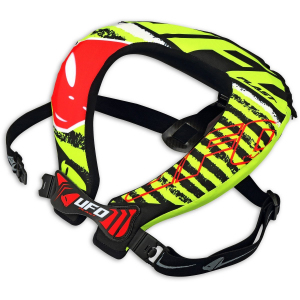

Neck brace for motocross riders
What is a motocross neck brace?
The motocross neck brace is a cervical vertebra protection device that is added to the motocross rider's equipment. Depending on the brand and model, it can be more or less bulky, with more or less components.
The motocross neck brace consists of a support harness, sometimes with two elastics, which is usually attached with Velcro fasteners. It requires a bit of gymnastics the first few times you put it on, but experienced riders don't mind. The fastenings are also designed so as not to interfere with the opening of the jacket, especially when reaching for something in the inner pockets.
Some cervical protectors run down the spine and rest directly on it. The support can be wider, so as to shift more to the shoulders and shoulder blades.
The weight must be as light as possible, while retaining its impact-resistance properties. It's not necessarily the bulkiest that are the heaviest, but the quality of the raw materials.
Last but not least, it's important to choose the right upholstery, which must be able to absorb temperature variations, especially in hot weather, as plastic that's too rough will quickly become unbearable. More suitable fabrics are often more comfortable.
Even if the motocross neck brace is sometimes very uncomfortable for many motocross riders, at tonnycat.com we consider it essential as part of the motocross rider's equipment.tonnycat.com considers it an essential part of any motocross rider's equipment.
What types of impact does it protect against?
Let's take a look at the history behind the creation of the motocross neck brace: it was the result of a single man and, unfortunately, a tragic accident. In the early 2000s, the son of Chris Leatt, a South African doctor and keen motorcyclist, was following in his father's footsteps on two wheels. Around the same time, Leatt witnessed the death of a rider while on the circuit. Eager to protect his son and future generations of motorcyclists, the doctor began developing a neck brace that would protect riders from injury.
Fractures of the neck and spine account for around 10% of all injuries sustained by motorcyclists in a crash or fall. Neck braces have been designed and marketed to mitigate these injuries in the event of impact. Even with a motocross helmet you can feel completely safe, but remember that your cross helmet only protects your skull, not your neck.
The aim of a motocross neck brace is to reduce cervical injuries after a head impact with a motocross helmet. The interaction between the neck brace and the helmet helps to distribute the force of the impact over the rider's shoulders. This reduces the pressure exerted on your vertebrae to prevent injury.
Clearly, the cross-country neck brace is there to protect the neck in the event of an accident. Although designs may vary, most braces do this by limiting head and neck movement in the event of a collision, while deflecting the effects of any impact onto other parts of the body, usually the shoulders or chest. Clearly, an orthotic cannot entirely prevent injury, but whatever the manufacturer or specific design, they are all intended to reduce the risk of serious neck injury in the event of an accident.
Above all, the cross brace is not just for adults, since on tonnycat.com we also offer cross braces for children.
What are the advantages and disadvantages of a motocross neck brace?
Motocross braces for MX and enduro riders offer protection by limiting the movement of the helmet - and therefore of your head - in the event of an accident. The design of the brace must limit forward, backward and side-to-side movement, preventing hyper-flexion - when the head is forced down towards the chest - or hyper-extension - when the head is forced back towards the spine. What's more, during such impacts, the base of the helmet strikes the structure, so the force of the impact is transferred to the cervical protection and the upper body or shoulders, rather than the neck.
Those who are skeptical about braces point out that there is an increased risk of clavicle injury in low-intensity collisions when the clavicles are sufficiently strong when hit from above. Moreover, given that the protection offered by the neck brace is for more serious accidents, risking your clavicle seems a reasonable compromise.
It's also worth noting that most modern braces are cleverly designed to break before the bones do, with manufacturers taking all the above factors into account. Since the widespread use of cervical protection, there has been a trend towards a decrease in cervical spine injuries, and no increase in clavicular or thoracic injuries.
Having established what cervical protection can do, let's look at what it can't. Whatever design or brand of neck brace you choose, its effectiveness is limited by the type of accident you have. None can offer complete and perfect protection if you're unlucky enough to land directly on your head, or in the case of a particularly violent impact. But, apart from this situation, the braces on the market are designed to offer both the freedom to ride, while offering greater protection in the event of an accident than riding without braces.
Among the drawbacks, some riders complain of the discomfort of the neck brace, which limits neck movement and sometimes poses compatibility problems with other equipment (see below), but don't lose sight of the fact that neck injuries can be life-threatening and certainly life-changing, so taking steps to minimize your risk is well worth a few minor inconveniences. Your choice should be based on the type of riding you adopt. If you're really taking risks, you're strongly advised to wear a neck brace.
Is this compulsory in competition?
While the wearing of back and chest protectors (such as motorcycle stone guardss) is often compulsory, there's no mention anywhere of the need to wear an adult cross-country neck brace or cervical protection of any kind.
At the end of 2008, the FFM decided to commission a study from INRETS, an applied biomechanics laboratory in the Faculty of the Hôpital Nord in Marseille, France.
After a year and a half of studies, the first results were made public by the FFM at the awards ceremony held in Paris in November 2010. Jacques Bolle, President of the FFM, issued the following statement:"Soft cervical protectors offer no added protection. Rigid collars, such as Leatt Brace, can, in some cases, provide additional protection, but not enough for the FFM to make them compulsory."
Indeed, following the tests carried out by INRETS, it would appear that the definitive conclusions are open to question. Again according to Jacques Bolle's statements, this time at the 2011 press conference, the two main lines that emerge are that:
- 1. Cervical collars made of excessively soft materials have no proven usefulness in the event of severe impact;
- 2. Rigid cervical collars are not infallible, but they do not pose any additional risk of injury. As it is impossible to scientifically assess the level of protection, the FFM has decided not to make neck braces compulsory.
Nevertheless, neck braces provide real protection and, even if they are not compulsory in competition, it is strongly recommended that you wear them, both in training and in competition, because remember, 10% of motocross falls injure your neck. And it's an area that's extremely important to you.
The best proof of this is to be found in the field, where neck braces are becoming increasingly commonplace, and more and more riders are adopting them.
Is a motocross neck brace compatible with other protective equipment for motocross riders?
The motocross neck brace is compatible with other protective equipment, it's just a question of choosing the right model. While many riders complain about discomfort at first, once they've got used to it, they no longer feel it, and instead feel liberated because they're safer.
Compatibility is a factor you need to consider with every piece of equipment you buy. This means that when you buy your motocross vest or cross stone guard, make sure it's suitable for wearing neck protection. On the other hand, when choosing your neck brace, check that it's compatible with the vest, stone guard and jacket you already own.
What's the difference between a low-end cross brace and a high-end cross brace?
There are several criteria for choosing a good neck brace:
- A simple soft neck brace is not enough: the brace must contain rigid protective parts;
- The weight should be as light as possible;
- The frame should be made of a material that can withstand high temperatures and is comfortable to wear;
- The neck brace should take up as little space as possible, so that you don't lose agility.
Just like a cross-country helmet, following an accident or violent impact, you need to change your neck brace, as it may have been weakened by the impact.
What brands of motocross neck braces do you offer on tonnycat.com?
We offer the following brands of neck braces on our site:
- Alpinestars neck straps
- EVS Quad and motocross neck rings
