



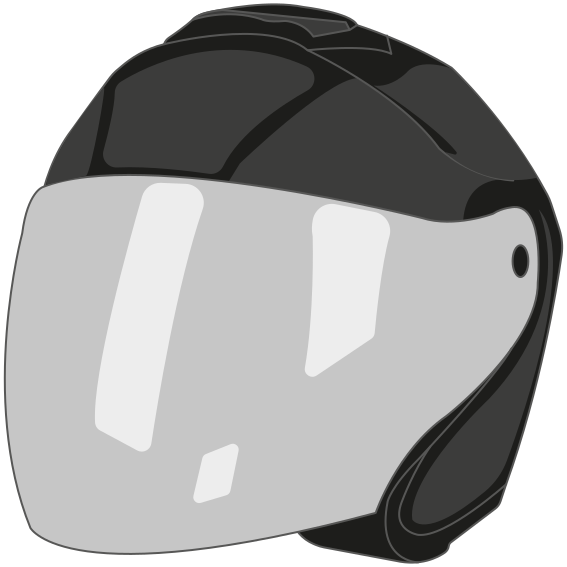
HELMET Quad and motocross helmets, jet or full-face helmets, adult or child






How to choose the right helmet?
What are the differences between a dirt bike helmet and an off-road helmet?
The differences between off-road motorcycle helmets, quad helmets and on-road motorcycle helmets lie directly in their design. In fact, each of these different motorcycle helmets has its own specific features to meet the needs of riders of these two-wheeled machines. For example, the difference between motocross helmets and motorcycle helmets specially designed for road use (or jet helmets) lies first and foremost in their compliance with various road safety standards, which impose a number of requirements on motorcycle helmet manufacturers, such as a defined number of reflective strips that must be fitted in certain specific areas of the motorcycle helmet. What's more, the different types of motocross helmets have technical features that the basic on-road motorcycle helmet does not.
These technical features are :
- Lighter weight, which gives the motocross rider greater comfort when riding on MX motocross terrain, for example. This difference in weight between a motocross helmet and a road-approved motorcycle helmet means greater freedom of movement for the wearer's neck. What's more, regional motocross or enduro competitions run by the FFM or UFOLEP last an average of 30 minutes. As a result, the rider's state of fatigue in enduro or cross-country riding would not be the same on a motocross helmet weighing between 1 and 1.5 kilograms, compared with a road-approved helmet which easily exceeds 2.5 kilograms.
- Greater eye opening. This design difference gives the motocross or quad rider greater visibility. This is particularly useful when the rider is competing in motocross or enduro races.
- A different visor between the road helmet and the motocross helmet for enduro or cross-country racing. The visor on a quad or motocross helmet is actually there to protect the rider from splashes and sunlight, which can sometimes be blinding and impair the rider's vision. What's more, cross-country helmets feature a more compact and elaborate chinstrap than traditional full-face helmets specially designed for road use.
- Better ventilation. Let's not forget that motocross and enduro are sports! And sport means perspiration. So it's vital that the rider's body (and especially the head) has the capacity to cool down quickly.
What are the different types of motocross helmet? And why is there such a difference?
To put it simply, there are two main types of off-road motorcycle and quad helmet:
Helmets specially designed for the sport of enduro riding and helmets specially designed for the sport of motocross. The motocross rider's choice of helmet depends on the discipline he or she is practicing. A motocross (or quad) helmet for enduro riding, for example, will be much lighter than a helmet for cross-country riding. This difference is explained by the time difference between the different events in these disciplines. In a cross-country event, for example, which lasts between 30 and 40 minutes, the strain on the motocross rider's neck will be less than in an enduro event, which can last several hours. This weight characteristic is also found on the range of quad enduro helmets we offer on tonnycat.com. And not all motocross helmets are created equal!
In fact, depending on the range in which you buy your motocross helmet, there will be differences between models in different ranges. At Tonnycat.com, we offer 3 main ranges of motocross helmets:
Classic" or "entry-level" motocross helmets.
These motocross helmets are mainly entry-level models that provide adequate protection, and are designed for people just starting out in the sport of off-road motorized 2-wheeling. The price of motocross helmets for "amateurs" or occasional motocross riders ranges from €90 to €150.
High-end" motocross helmets,
are aimed more at hard-core motocross riders who compete in the sport. These motorcycle helmets are designed for regular users and have the following special features:
- They are fully customizable in terms of cap, helmet comfort foam and accessories.
- The material used to build the shell of the motocross helmet is mainly carbon fiber or fiberglass, to guarantee foolproof strength in the event of impact, keeping the rider's head safe while drastically reducing the weight of the motocross helmet, guaranteeing unrivalled comfort for the motocross rider.
- The quality of the foams inside the helmet are specially designed for better shock absorption, and are generally fully removable, with a built-in anti-microbial system.
- The inner shell is generally made of highly shock-absorbent EPS foam, which increases the rider's safety in the event of a serious fall at high speed during a competition.
- Please note: some motocross helmets are incompatible with motocross neckbands.
- Top-of-the-range motocross helmets are ECE 22/05 and DOT approved.
The third range is a little more specific, and consists of modular helmets.
This last type of full-face helmet features a visor that folds down for improved aerodynamics.
How do I choose a motocross helmet, and what are the criteria for purchasing a motocross helmet?
To choose the right motocross helmet, you need to take into account 6 essential criteria.
1 - Weight: Weight is a decisive criterion in the choice of your helmet. As mentioned above, there are two main motocross disciplines: cross-country and enduro (endurance). These two motocross disciplines do not have the same time limits. Enduro events last longer than cross-country competitions. That's why it's vital to choose the right helmet for your weight and the type of competition or activity you'll be taking part in. If your enduro competition or your cross-country sessions with friends last several hours, then you'll obviously want a cross-country helmet weighing between 1,000 and 1,300 grams. A lighter motocross helmet will avoid that stiff neck feeling, which will objectively improve your comfort.
2 - Resistance to mechanical impacts: The purpose of a motocross helmet is relatively simple: to protect your head from mechanical impacts (motocross crashes, impact with an object on the enduro course, etc.) during FFM or UFOLPE competitions, for example.
There are two parts to a motocross helmet that protect your head:
- The helmet shell, which is made of carbon fiber (or composite fiber) for the lightest models. The heavier cross-country helmets have polycarbonate shells. The advantage of a fiber (composite or carbon) helmet is that the shell of the cross helmet will "work" or "deform" to absorb a large part of the shock, leaving the rest of the shock wave to be absorbed by the cross helmet's foams.
- The second part of the helmet that protects your head by absorbing shock is the thick foam inside. In top-of-the-range motocross helmets, the foams can usually be unclipped, which offers a huge hygienic advantage: you can wash them.
3 - Ventilation: Ventilation is an essential criterion when choosing a cross helmet, for obvious reasons of comfort and safety. The cross-country helmets we offer on tonnycat.com come in a range of ventilation modes, including front ventilation, hypoallergenic ventilated fabric and Silvercool technology.
4 - The cross helmet fastening system: The only fastening system tolerated by the judges at the pre-competition technical inspection is the "Double D" system. This is the most reliable and safest system for riders. If you want to compete, then we strongly advise you to pay close attention to the type of fastener used in the model of cross enduro or mx helmet you select.
5 - Homologation: It's important to know that in the context of an official competition, the referees will carry out a technical inspection, and helmet inspection is of course part of the checklist. A competition-approved helmet that passes the technical inspection will be less than 5 years old from the time it leaves the factory. The helmet must also be undamaged and have a double-D closure at the chinstrap. To check that the helmet is less than 5 years old from the time it left the factory and complies with current safety standards, consult the label on the chinstrap of the MX cross helmet or enduro helmet.
6 - Your motocross helmet must be compatible with your mask: Most brand-name motocross helmets are compatible with your motocross mask. However, this is not a general rule for all brands and models.
7 - Check the compatibility of accessories: The motocross rider's equipment is varied and multifaceted. You may need a cross-country neck brace, for example, so it's imperative to check whether your helmet is compatible with such safety equipment for cross-country or enduro riding. What are the best motocross helmet brands? On our website (tonnycat.com) we offer several brands of motocross helmets. However, we'd like to draw your attention to the following brands:
Of course, we also offer other brands of motorcycle helmets for cross-country and enduro riding - just go to this page.
What accessories are compatible with a motocross helmet?
There are several accessories that are essential for a motocross helmet! The first must-have motocross accessory is motocross goggles. These are essential to protect the rider's eyes from splashes, water and mud! The second accessory that may be compatible with certain models of cross helmet is the cross neck brace, which is a cross rider's piece of equipment that protects the back of your neck in the event of a bad fall during a competition or a session with your fellow riders. It's also essential that the graphic style of your motocross helmet matches your motocross outfit! It's all about style in MX competition!
What are the criteria for choosing the right size motocross helmet?
It's important to choose the right size for your head, for obvious safety reasons. We advise you to take a tape measure and measure the circumference of your head starting 2.5 cm above the eyebrows, keeping straight. The number of centimeters in your head circumference will tell you which size to buy, as the size tabs indicate the corresponding head circumference in cm. In case of doubt, we advise you to always take the smaller size, for the simple reason that over time, the foams in your helmet will settle, resulting in a slight gap between the helmet and your head. To make your choice easier, tonnycat.com offers two categories of helmets:
- Children's motocross helmets
When should I change my helmet?
Generally speaking, if you've been taking care of yourself and haven't had any major knocks with your helmet, then it's advisable to change your helmet. However, with use, the foams in your helmet very often settle. This has a dual effect. The first effect is that the absorption of a shock wave in the event of a fall (for example) is no longer as optimal as it was when the helmet left the factory. The second effect is that your helmet won't fit as well on your head, which will make it less comfortable to wear. It's worth noting that, over time, the shell becomes brittle due to the usual micro-shocks associated with cross-country or enduro riding, humidity, temperature variations, UV rays from the sun, etc. If you find that the shell of your helmet has lost its hardness, cracked or cracked, you need a new motocross helmet.
How do I look after my motocross helmet?
If you're lucky enough to have a motocross helmet with removable foams, we advise you to remove these foams and clean them to ensure impeccable hygiene once the helmet is on your head. Also, if your foams start to pack down, don't hesitate to change them. To preserve the life of your motocross helmet, we also recommend keeping it in a dry place away from direct sunlight. This will prevent the outer shell from deteriorating rapidly and enable it to retain its mechanical shock-absorbing performance.
Our cross helmets by brand :
- acerbis helmets
- alpinestars helmets
- answer helmets
- bell helmets
- freegun helmets
- just1 helmets
- oneal helmets
- shot helmets
- swaps helmets
- thor helmets
By color :